
Designing for the Dashes
Schools are designed around lessons as the core part of the school day. Timetables tell us when learning starts and ends. Teachers plan what pupils will learn, how they will learn it and what they will need to succeed, and policies are built around that in turn.
But what happens in the dashes in between?
The journey from the school gate to the classroom. Moving from a noisy playground into a lesson. The walk from PE back to a desk. The lunch queue, the changing room, the corridor and the few minutes waiting outside the next classroom.
These moments can be easy to overlook but for many young people with SEND, they can be some of the most demanding parts of the school day. When we think about inclusion, our attention naturally goes towards the classroom and whether the resources are accessible and whether the teaching has been adapted.
But the transition itself is part of the learning environment.
Every transition asks a young person to stop one activity and start another. They may need to process a change in environment, noise, expectations, relationships or sensory input, while also regulating their emotions and preparing themselves for what comes next.
For some pupils, this happens almost invisibly. For others, each transition can be a significant challenge and repeated throughout the day, the cumulative impact can affect how they feel and behave when they arrive at the next lesson.
It raises the question of whether we need to design these dashes with the same intentionality with which we design lessons.
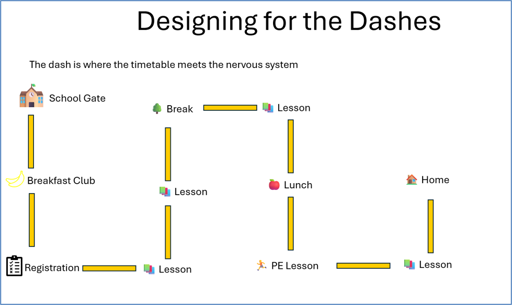
Designing the Dashes
Designing the dash means considering what happens between activities and deliberately creating the conditions pupils need to make the next step successfully. Rather than thinking about simply how to get pupils from A to B, we should be considering how we want pupils to feel when they arrive at B.
1. Design for predictability
Transitions can become difficult when pupils do not know what is coming next. Consistent routines, visual timetables, countdowns and clear expectations can reduce uncertainty and help pupils understand what to expect.
2. Design for regulation
For some pupils, moving from a busy playground straight into a demanding lesson can mean carrying the energy, noise or emotions of one environment into another. Creating a short opportunity to reset can help bridge the gap.
This could be a breathing routine, a calm entry task, a sensory activity or a simple movement opportunity before learning begins. Sport Sanctuaries provides practical examples of how schools can use space and activity creatively to support children to regulate as they enter and move around school.
3. Design the environment
Think about the spaces pupils move through every day. Are corridors crowded and noisy? Is there somewhere to pause? Could a space be used differently at different points of the day? Are there opportunities for quieter movement or activity?
4. Design adult interactions
A transition also means moving from one adult’s style to another, or from a safe relationship into a less familiar space. A greeting can help a pupil feel seen and a moment of connection can help a young person co-regulate before they are expected to manage themselves independently.
A pupil who arrives dysregulated may not need another instruction. They may first need an adult to help them feel safe and ready to engage.
Making movement part of the solution
Perhaps most importantly, movement should not simply be viewed as a way of transporting pupils from one place to another. Physical activity is often positioned as something which sits alongside learning: part of the school day but separate from the core elements of academic learning.
However, movement can be a tool for supporting regulation and readiness to learn. For a pupil who finds sitting still for long periods difficult, a movement opportunity can help them return to learning. For a pupil who becomes overwhelmed by a busy transition, a predictable active route or quieter movement option can provide structure. For another, simply having permission to move can help them remain engaged rather than reaching the point of dysregulation.
That could mean active registration, movement breaks between lessons, opportunities to walk rather than wait, or active playground spaces. This does not mean creating a new intervention for every pupil or turning every transition into a PE lesson, but thinking about how we can use intentional movement to help more young people successfully navigate the school day.
Designing for inclusion can benefit everyone
Many of the changes which make school more accessible for one group can improve the experience of the whole school community. More opportunities for movement can support concentration and wellbeing. Less reliance on sitting still can benefit pupils with different learning preferences. Predictable routines can reduce anxiety for many children.
Physical activity is a particularly powerful part of this because it has so many physical, mental and social benefits that can support well-rounded development for all young people and help them participate more fully in school life.
Where can schools start?
Schools do not need to redesign their entire timetable to start thinking differently about transitions. Start by choosing one “dash” in the school day which regularly presents a challenge. Ask pupils and staff what makes it difficult. Then consider what could make the transition more predictable.
The Sport Sanctuaries approach provides practical examples of how schools can use their existing spaces and simple activities to create environments which support regulation and inclusion.
The idea of the “dash” is useful because it reminds us that the school day is not simply a series of lessons. It is a continuous experience. For young people with SEND, those moments between the big blocks can determine whether they are able to participate and learn when they reach the next one.
Designing for those moments means taking physical activity and movement out of the margins of the school day and recognising their potential as tools for inclusion.
The DASH Framework
Discover
Where are the difficult transitions?
Anticipate
Reduce uncertainty and overload
Support
Movement • Relationships • Regulation
Help
Every child arrive ready to learn